
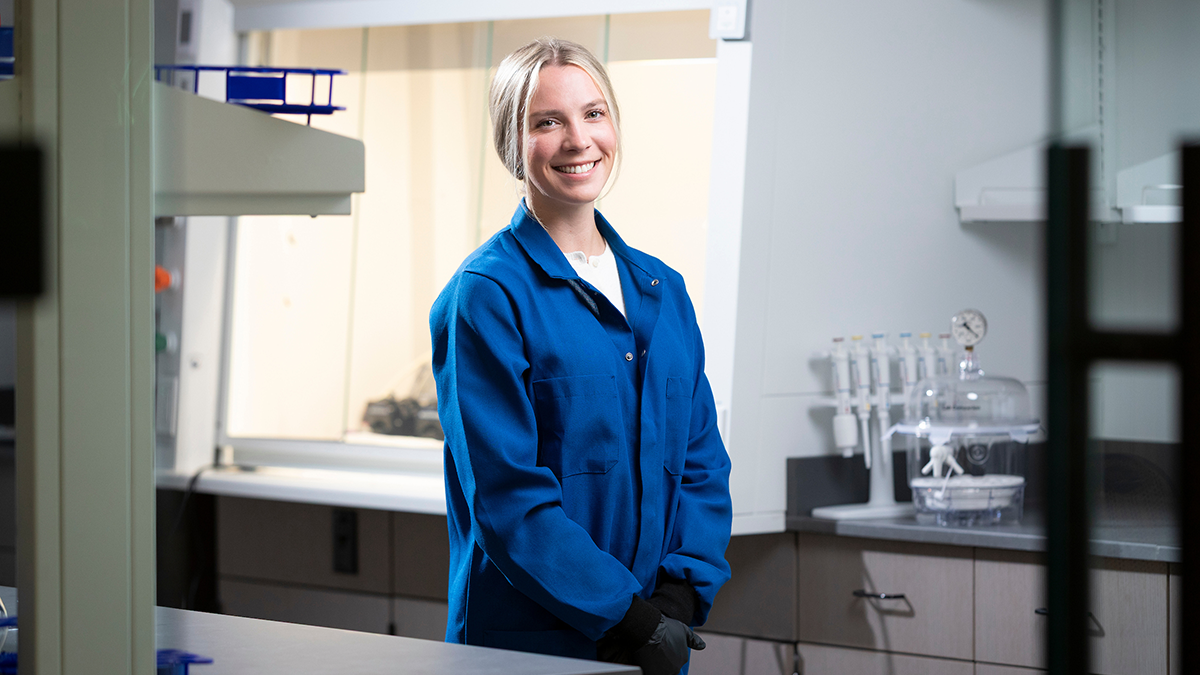
Florida State University doctoral student Bailey Lake poses in professor Jamel Ali's lab in the Interdisciplinary Research and Commercialization Building in Tallahassee, Florida on May 19, 2026. Lake is a recipient of the U.S. Department of Energy’s Science Graduate Research (SCGSR) Award which will allow her to conduct research at Oak Ridge National Laboratory in Tennessee. (Scott Holstein/FAMU-FSU College of Engineering)
Bailey Lake is heading to one of America’s leading national research labs—and she’s taking a problem worth solving with her.
Key points
- Lake is one of 75 students nationally to receive the DOE SCGSR Award
- She will conduct research at Oak Ridge National Laboratory in Tennessee
- Her work focuses on using magnetic fields to improve rare-earth element recovery
- Lake works in the Center for Rare Earths, Critical Minerals and Industrial Byproducts at the National High Magnetic Field Laboratory
- Rare earth elements are critical to smartphones, medical devices, electric vehicles and wind turbines
- The third-year doctoral candidate in materials science and engineering at the FAMU-FSU College of Engineering is one of 75 students nationwide selected for the U.S. Department of Energy’s Science Graduate Student Research (SCGSR) Award. She will investigate whether magnetic field gradients could improve how critical minerals are extracted and separated from industrial waste.
The third-year doctoral candidate in materials science and engineering at Florida State University and the FAMU-FSU College of Engineering is one of 75 students nationwide selected for the U.S. Department of Energy's Science Graduate Student Research (SCGSR) Award. She will conduct dissertation research at Oak Ridge National Laboratory in Tennessee, investigating whether magnetic field gradients could improve how critical minerals are extracted and separated from industrial waste.
Through Florida State University, the joint college participates in Oak Ridge's Core Universities program.
Why Rare Earths Matter
Rare earth elements sit inside many of the technologies people use daily, such as smartphones, medical devices, electric vehicles and wind turbines. The United States currently relies heavily on other countries for its supply, making domestic recovery methods a national priority.
Lake’s research aims to change that. She’s developing an approach that uses magnets to improve the chemical separation process, capitalizing on the fact that rare-earth elements respond differently to magnetic fields.
“Right now, separating these elements is tough. It’s energy-intensive, expensive and produces a lot of waste,” Lake said. “I’m working on a new approach that uses magnets to improve chemical separation. Because rare earth elements react differently to magnetic fields, we might be able to sort and recover them more efficiently and cleanly.”
A central part of her work involves turning industrial waste into a new source of critical minerals—treating byproducts not as problems to dispose of, but as resources to recover.
Research at the Magnet Lab
At the joint college, Lake works in the Center for Rare Earths, Critical Minerals and Industrial Byproducts at the National High Magnetic Field Laboratory, mentored by professors Jamel Ali, Munir Humayun and Theo Siegrist.
The SCGSR program will allow her to extend that work alongside researchers at Oak Ridge, with access to facilities and expertise not available elsewhere.
“I’m extremely grateful for the DOE SCGSR award,” Lake said. “This is an incredible opportunity to push my dissertation research forward and contribute to solutions that could make critical mineral supply chains stronger and technologies more sustainable for everyone.”
For Lake, the fellowship is also a window into what a career at a national laboratory could look like. “Programs like the DOE SCGSR mean everything for young researchers like me,” she said. “They open doors, giving us a chance to learn from leading scientists, access amazing facilities and shape the future of science.”
Editor’s Note: This article was edited with a custom prompt for Claude Sonnet 4.6, an AI assistant created by Anthropic. The AI improved clarity, structure, SEO/GEO optimization and readability, while preserving the original reporting and factual content. All information and viewpoints remain those of the author and publication. This article was edited and fact-checked by college staff before being published. This disclosure is part of our commitment to transparency in our editorial process. Last edited: 06/17/2026.
RELATED ARTICLES
FAMU-FSU Researchers Repurpose Fuel Cell Membranes for New Applications