
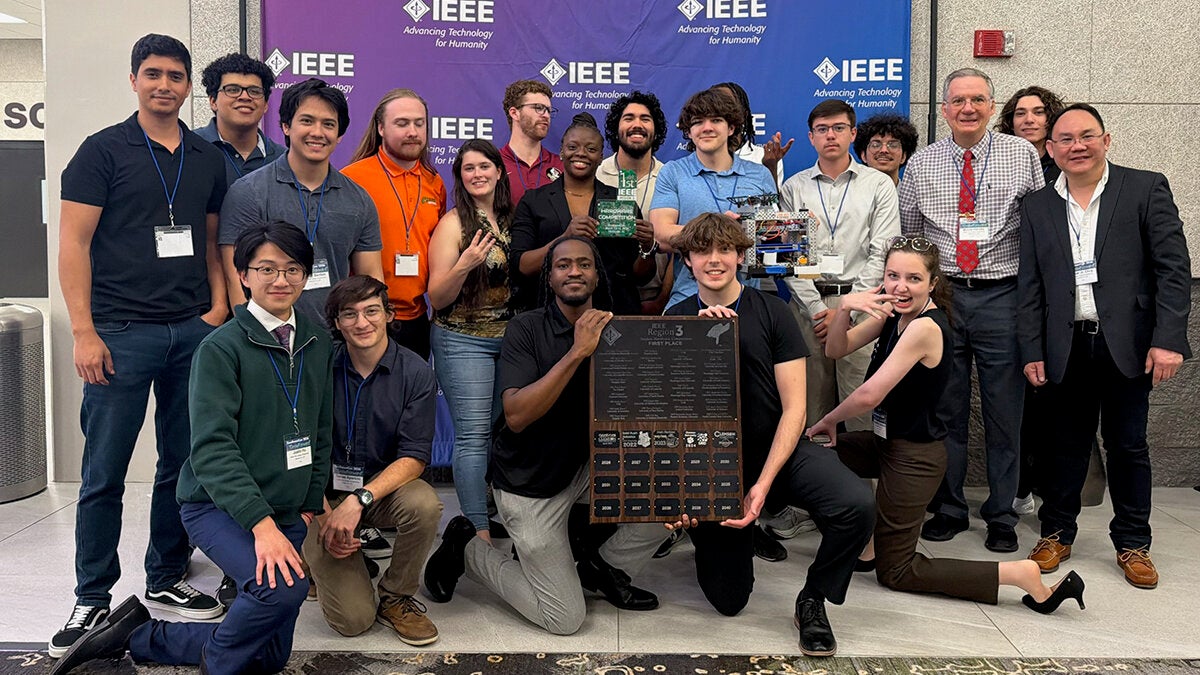
The winning senior design team members from the 2026 IEEE SoutheastCon Hardware Competition in Huntsville, Alabama. (Courtesy A. Harris)
KEY POINTS
- Two senior design teams from the FAMU-FSU College of Engineering claimed first place at the 2026 IEEE SoutheastCon Hardware Competition, held March 13-15 at the Von Braun Center in Huntsville, Alabama.
- The winning teams (ECE Team 301 and MAE Team 527) included students Samuel Artecona, Nicholas Brown, Lucas Girala, Cricket Skipper and Rhonda Smith, along with competitor Alexander Harris.
- Competing against student engineers from across the Southeast, the teams solved a multi-stage robotics challenge under live, timed conditions.
- Their win demonstrates the applied engineering preparation students receive through the FAMU-FSU College of Engineering’s joint program between Florida A&M University and Florida State University.
Two student senior design teams from the FAMU-FSU College of Engineering took first place at the 2026 IEEE SoutheastCon Hardware Competition.
The annual conference ran March 13-15 at the Von Braun Center in Huntsville, Alabama, drawing an estimated 500 to 600 students and 200 to 300 IEEE professionals from across the Southeast region. (Attendance figures are estimates published by IEEE SoutheastCon 2026 organizers.)
The two winning teams were ECE Team 301 and MAE Team 527, which included:
- Samuel Artecona
- Nicholas Brown
- Lucas Girala
- Cricket Skipper
- Rhonda Smith
- Alexander Harris
- Tommy Buretz
- Alejandro Caro
- Henry Forero
- Josue Villarreal
- Tyler Morgan
- Nathan Gibbs
What Was the 2026 IEEE SoutheastCon Hardware Competition?

The competition challenged student teams to solve a multi-stage robotics and communications scenario under a strict time limit.
In the problem scenario, a group of fictional “Astro-ducks” had lost contact with Earth and were scattered across a simulated space map. Teams had to locate all the Astro-ducks and return them to a secure zone using an autonomous moving robot. Simultaneously, they were required to repair four broken antennas, restore communication with Earth and transmit a message—all before the clock ran out.
The challenge tested students on robotics, navigation, systems integration and real-time problem-solving.
How Did the Joint College Teams Prepare?
Preparation centered on both engineering reliability and strategic efficiency. The joint college teams built out a detailed materials inventory with emergency backups, refined the robot’s pathing and navigation systems, and mapped out how to allocate their time across each phase of the challenge.
That groundwork paid off during competition. When stadium lighting caused the robot’s camera to misread LED color signals, the teams diagnosed the problem quickly and adjusted the camera’s exposure settings. When that fix proved insufficient—ambient light from the venue was still triggering false color reads—they went further, physically blocking the light sources from reaching the sensors.
How Did the Teams Come From Behind to Win?
Entering the finals, the teams were down by 10 points. Within two hours, they designed and deployed two new solutions: launching a drone and implementing a hex bug system that extended the robot’s operational range inside the competition’s simulated crater zone. The combined improvements pushed their score from 205 to 270, enough to take first place.
The ability to rapidly prototype and test under competitive pressure reflected months of preparation and, according to the team, the collaborative culture of the college itself.
“We’ve developed both our technical skills and confidence as engineers,” said Harris. “It gave us the opportunity to apply engineering principles in real, practical ways. It also strengthened our teamwork and problem-solving abilities, which were essential during the competition.”
What Did the Competition Experience Mean for the Students?
Beyond the first-place finish, the competition gave the joint college students an opportunity to build professional relationships with peer teams from other universities and gain a clearer sense of what engineering under pressure demands.
For the team, the win validated the preparation they had invested and reinforced why competitions like SoutheastCon matter for engineering students entering the workforce.
Editor’s Note: This article was edited with a custom prompt for Claude Sonnet 4.6, an AI assistant created by Anthropic. The AI optimized the article for SEO/GEO discoverability, improved clarity, structure and readability while preserving the original reporting and factual content. All information and viewpoints remain those of the author and publication. This article was edited and fact-checked by college staff before being published. This disclosure is part of our commitment to transparency in our editorial process. Last edited: 04/01/2026.
RELATED ARTICLES
Mechanical Engineering Students Capture Recognition at FSU Op-Ed Competition
Barbot wins “People’s Choice Award” in 2022 ACC InVenture Prize Competition
FAQ
What is the IEEE SoutheastCon Hardware Competition? IEEE SoutheastCon is the annual technical and student conference for IEEE Region 3, which covers the southeastern United States. The hardware competition challenges student teams to design and operate robotic systems that complete a series of engineering tasks under a strict time limit. The 2026 conference was held March 13-15 at the Von Braun Center in Huntsville, Alabama.
What is the FAMU-FSU College of Engineering? The FAMU-FSU College of Engineering is a joint academic institution operated by Florida A&M University and Florida State University, located in Tallahassee, Florida. It offers undergraduate and graduate degrees across multiple engineering disciplines, including electrical and computer engineering (ECE) and mechanical and aerospace engineering (MAE). The college is noted for its diverse student body and research programs.